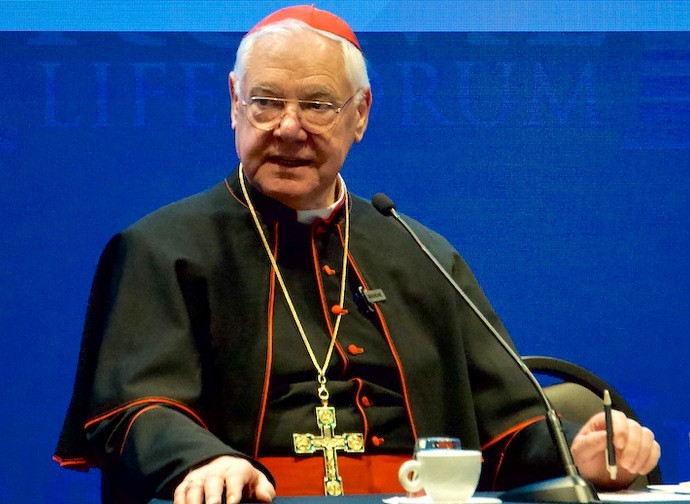
Cardinal Gerhard Ludwig Müller, a leading figure in the Catholic Church and former Prefect of the Congregation for the Doctrine of the Faith, is no stranger to controversy. His theological expertise and forthrightness on various issues have made him a prominent voice within Catholic circles. Recently, Müller sparked a wave of discussion and debate when he made a striking statement: “We cannot be a good Catholic and be a Communist, or accept the Woke Ideology.”
This powerful assertion touches on two key issues that have been growing in influence within the modern world: political ideologies and cultural movements. To understand the full significance of this statement, one must consider not just Müller’s position on Catholic doctrine, but also the intersection of faith, politics, and culture in the modern world.
Understanding Cardinal Müller’s Position
Cardinal Müller’s comment brings together two distinct yet highly debated topics—Communism and the Woke Ideology. For context, the Catholic Church has always had a nuanced approach to politics, emphasizing that faith should transcend political divides while still encouraging active engagement with societal issues.
Historically, the Catholic Church has critiqued ideologies like Communism for their materialistic view of society, which often disregards the dignity of the human person and the importance of individual freedoms. Communism, with its emphasis on the collective over the individual, has long been seen as contrary to Catholic social teachings that uphold the dignity of each human being as a creation made in the image of God.
Müller’s statement on Woke Ideology is equally provocative. The rise of woke culture, with its emphasis on identity politics, social justice, and the rejection of traditional societal norms, has sparked concerns among many religious leaders about the erosion of moral absolutes. For Müller, this ideology represents a shift away from the absolute truths of Catholicism in favor of moral relativism and a social agenda that he views as incompatible with the core teachings of the Church.
The Catholic Church and Political Ideologies
The relationship between Catholicism and politics is not new, and it has been shaped by centuries of theological reflection. From the Papal States in the medieval era to the Church’s influence in modern European politics, Catholicism has maintained a presence in political discourse. However, the Church’s stance on political ideologies has often been cautious, prioritizing ethical and moral teachings over allegiance to any one political system.
One of the Church’s central teachings is the principle of subsidiarity, which emphasizes that societal issues should be addressed at the lowest level possible—whether through families, communities, or local governments. This principle stands in stark contrast to ideologies like Communism, which centralizes power in the hands of the state, undermining individual freedom and the capacity of smaller institutions to function.
Similarly, Catholic teachings on social justice focus on the dignity of the human person, the importance of private property, and the need for solidarity with the poor. While the Church does advocate for the protection of the marginalized and the establishment of just systems, it does so from a standpoint of human dignity rather than one of collective control, as is often seen in socialist or Communist ideologies.

The term “Woke Ideology” has become ubiquitous in recent years, particularly in the United States. Woke culture is rooted in a belief in social justice and awareness of societal inequalities, particularly concerning race, gender, and sexuality. It advocates for the dismantling of systems of oppression and seeks to raise awareness about issues like racism, privilege, and inequality.
However, while these goals may seem noble on the surface, critics, including Cardinal Müller, argue that the Woke Ideology goes beyond its original intent. It has evolved into a movement that not only advocates for social justice but also imposes a specific set of moral and cultural norms that challenge traditional values. The ideology emphasizes identity politics, moral relativism, and the rejection of traditional concepts of truth and justice.
For Catholics like Müller, the Woke Ideology presents a problem. It undermines the absolute moral truths that the Church holds dear, including the sanctity of life, the definition of marriage, and the understanding of gender as being rooted in biological reality. The Woke Ideology’s focus on fluidity, particularly with regard to gender identity and sexual orientation, is seen by some as in direct conflict with the Church’s teachings on the nature of human beings as created by God.
The Conflict Between Faith and Political Ideologies
At the heart of Cardinal Müller’s statement lies the tension between the absolutes of Catholic faith and the relative, often fluid nature of political ideologies like Communism and Woke culture. For many Catholics, this presents a moral dilemma. How can one remain faithful to the teachings of the Church while navigating the increasingly complex and politically charged landscape of modern society?
The Church teaches that moral truths are not subjective; they are rooted in divine law. This law, as articulated through Scripture and Tradition, provides a framework for understanding human nature and guiding societal behavior. The problem with ideologies like Communism and Woke culture, according to critics like Müller, is that they are based on human constructs that change with time, culture, and political climates.
In contrast, Catholicism upholds the idea that truth is unchanging. The Church’s moral teachings on issues like the sanctity of life, the nature of marriage, and human dignity are not negotiable or subject to popular opinion. They are divinely revealed truths that guide the faithful in all areas of life.

Implications for Catholics Today
Cardinal Müller’s stance has significant implications for Catholics in today’s world. As society becomes more polarized and ideologically driven, Catholics must navigate the complexities of these movements while staying true to their faith. While the Church encourages engagement with the world, it also reminds Catholics that their first loyalty must be to God and His teachings.
Catholics must grapple with how to engage with political movements that may promote values contrary to their faith. This does not mean that they must completely reject social justice or activism, but they must approach these movements critically, ensuring that their actions align with the moral teachings of the Church. The Church’s focus on charity, solidarity with the poor, and the common good provides a framework for engaging in social issues without compromising on faith.
Counterarguments and Broader Perspectives
While Cardinal Müller’s views are shared by many within the Church, not all Catholics or religious figures agree with his assessment. Some argue that the Church should be more flexible and open to engaging with social movements like the Woke Ideology, particularly when it comes to advocating for the poor, marginalized, and oppressed. They argue that the Church’s moral teachings on love, justice, and care for the poor can align with the goals of these movements, even if they do not align on every issue.
Moreover, some believe that political ideologies, including socialism or progressive movements, can be aligned with Catholic social teachings, particularly when it comes to advocating for economic justice, environmental stewardship, and social equity. These Catholics believe that the focus should be on the common good, which may involve engaging with political movements that challenge established norms.

Faith, Ideology, and the Future
In the end, Cardinal Müller’s statement calls for reflection on how Catholics can remain faithful to their beliefs in a rapidly changing world. It challenges Catholics to examine how their faith intersects with contemporary political ideologies, especially those that are rapidly growing in influence like Communism and the Woke Ideology.
As society continues to evolve, it is clear that Catholics must engage with these ideologies critically and thoughtfully. While political ideologies may change, the truths of the Catholic faith remain constant. It is through this lens of unwavering truth that Catholics can navigate the complexities of modern life, ensuring that their actions always reflect the dignity and worth of every human person, and the absolute truths revealed by God.